
Microsoft named a Leader in AI-Augmented Code Modernisation: What It Means for Businesses
Microsoft has been named a Leader in the inaugural 2026 Gartner® Magic Quadrant™ for AI-Augmented Code Modernization Tools, marking an important milestone in the growing role of artificial intelligence in application modernisation.
But the recognition points to something bigger than Microsoft’s position in the market.
As organisations look to adopt AI, many are discovering that legacy applications, outdated infrastructure and growing technical debt can stand in the way. Ai-powered modernisation is emerging as a way to address these challenges faster and create stronger foundations for future innovation.

What is AI-augmented code modernisation?
Traditional application modernisation can be a complex and time-consuming process. Organisations may need to assess existing systems, identify dependencies, rewrite or upgrade code, migrate workloads and continuously test changes along the way.
Microsoft is increasingly bringing agentic AI into this process.
Through capabilities across GitHub Copilot and Azure Copilot, AI agents can assist teams throughout the modernisation lifecycle while keeping developers in control of decisions and review.
Microsoft describes its approach Agentic Modernization on Azure, built around three connected stages:
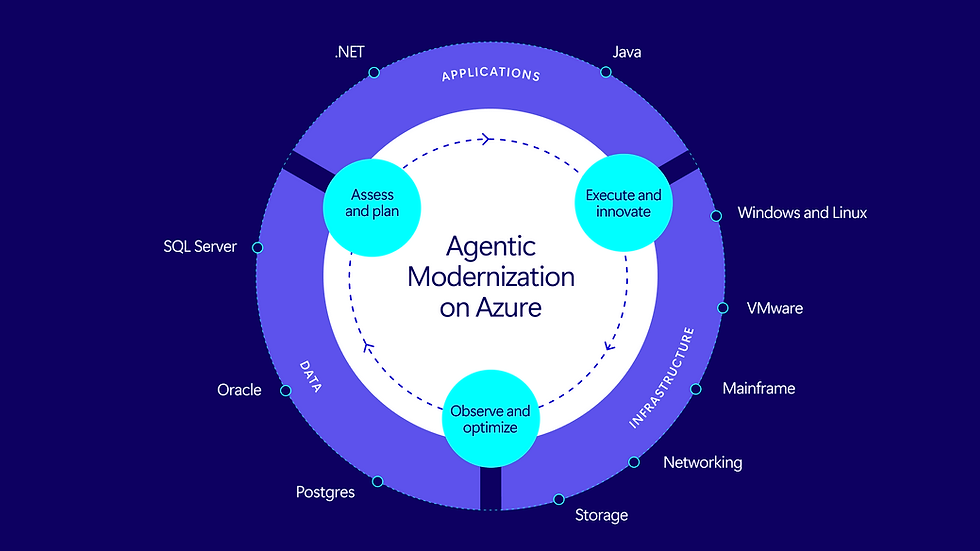
Assess and plan - understand existing environments, identify dependencies and determine modernisation priorities.
Execute and innovate - support the transformation and migration of applications, data and infrastructure
Observe and optimise - continuously monitor and improve modernised environments.
This approach extends across technologies including .NET, Java, SQL Server, Oracle, PostgreSQL, Windows and Linux, VMware, mainframe environments, networking and storage.
The impact is already being seen
The potential benefits aren’t just theoretical.
According to Microsoft, customers using GitHub Copilot modernisation capabilities have reported up to 70% less time spent on migration efforts and 50% less effort required to upgrade applications.
Microsoft also reports that more than 1.4 million developers have installed the GitHub Copilot modernisation experience.
In some customer examples highlighted by Microsoft, modernisation projects involving hundreds of thousands of lines of code have been completed in weeks rather than the months or years traditionally associated with large-scale transformation.
These results demonstrate how AI can change not only what organisations modernise, but the speed and scale at which modernisation can happen.
Why modernisation matters for AI readiness
For businesses, modernisation is becoming about more than replacing ageing technology.
Legacy systems can create technical debt, increase complexity and make it harder for organisations to take advantage of emerging technologies. As AI becomes embedded across business operations, having modern applications, data and infrastructure becomes increasingly important.
This creates a connection between modernisation and AI readiness.
By using AI to help assess existing environments, automate repetitive transformation work and support developers throughout migration, organisations can potentially move towards modern platforms faster while freeing their teams to focus on higher-value work.
Importantly, Microsoft’s approach doesn’t remove people from the process. Human review remains part of the modernisation workflow, with the developers maintaining oversight of AI-generated recommendations and changes.
From legacy systems to an AI-ready future
Microsoft’s position in the 2026 Gartner® Magic Quadrant™ reflects a broader shift happening across enterprise technology.
AI is no longer only something organisations add after modernisation. Increasingly, AI is becoming part of the modernisation process itself.
For organisations still operating with legacy applications and infrastructure, this creates an opportunity to rethink modernisation not simply as an IT upgrade, but as part of preparing the business for what comes next.
As AI capabilities continue to evolve across Microsoft Azure and GitHub, the path from legacy technology to an AI-ready environment is becoming faster, more intelligent and increasingly agent-driven.
Want to learn more?


Comments